Posted on Tuesday, November 04 2003 @ 23:59 CET by Thomas De Maesschalck
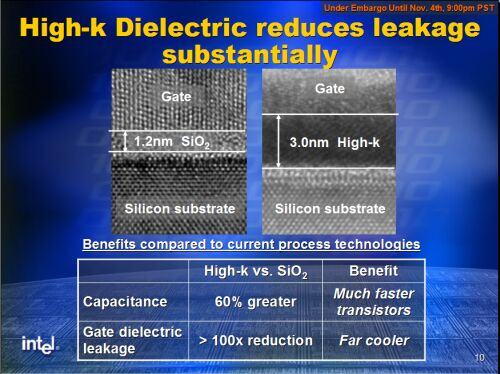
Normally a transistor gate excists out of a layer of silicumdioxyde which serves as an isolator, but because transistors are becoming smaller and smaller this layer is becoming too small. Because of this the power leakage becomes too high, and this results in leaked unused power which causes increased heat. It also has a negative impact on the switching speed.
Because of this Intel started research for a new transistor isolator material five years ago. This new material must make it possible to make wider gates, and it should also have a higher dielectrical constant than silicumdioxyde (>3.9). These materials are also refered to as High-K materials.
The interaction between a material with a high dielectrial constant and a polycristal line silicum (the rest of current transistors are made out of this material) causes a few problems however. First there should be no irregularities between the two materials, otherwise the switching voltage becomes too high. They also speak of an effect called 'Phonon scattering', this is related to quantum mechanics which causes slower moving electrons.br>
Intel also found a solution for this problem by replacing the polycristal line silicum with a new metal in combination with a new and special manufacturing process.
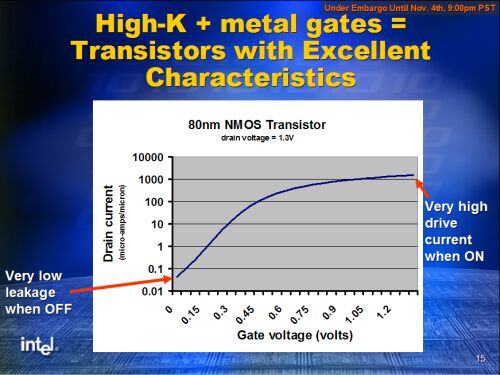
The result is a High-K metal gate transistor, with as good as no power leakage when he is turned off.
Intel expects that they will be able to use this new transistor in 2007 for their P1266-proces, and that they will be able to make them at 45 nanometer.
Source: Tweakers (Dutch)