DailyTech
reports Microsoft and Anna Pyayt, a graduate student from the University of Washington, have developed a new display technology that offers much better energy efficiency than LCD displays:
The new technology uses optics that are similar to those used in telescopes.
According to IEEE Spectrum, a typical LCD in use today is backlit and less than 10% of the light produced by the backlight is transmitted to the surface of the LCD screen. The polarizing layer alone absorbs 50% of the light output from the backlight.
The telescopic design on the other hand is able to transfer about 36% of the light produced to the surface in prototypes using reflective optics. The telescopic pixel has a tiny primary mirror facing the backlight with a hole in the middle. A smaller secondary mirror located 175 micrometers behind the primary mirror faces it and reflects light making it though the primary mirror back. When voltage is applied to the primary mirror it turns into a parabola and allows light to be focused on the secondary mirror and onto the screen.
The researchers say that in theory, as much as 75% of the light in the telescopic pixel display could reach the surface of the screen. Another benefit of the design is a much higher rate of speed at which the pixels can be turned on and off. The telescopic pixel can go from dark to light in 1.5ms.
 Posted on
by Thomas De Maesschalck
Posted on
by Thomas De Maesschalck 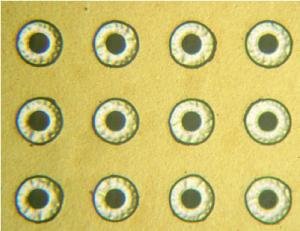

Comments (0)
No comments yet.