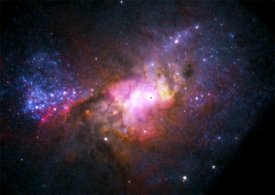
Astronomers have discovered have discovered a black hole about a million times the mass of a star inside the nearby dwarf galaxy Henize 2-10. The discovery provides further evidence for the theory that black holes may play a vital role in the formation of (some?) galaxies.
Henize 2-10 lacks a bulge — a dense collection of stars that exists at the center of most spiral galaxies. Usually, the mass of a galaxy's bulge directly correlates with the mass of its central black hole. Some researchers thought a galaxy had to already have a bulge before a black hole could form.
"This definitely suggests the black hole comes first, because Henize 2-10 is a very low-mass dwarf galaxy without a detectable bulge, yet it does already have a supermassive black hole sitting there," said study leader Amy Reines, a graduate student at the University of Virginia. "So the implication is you don't have to have a bulge to form a black hole."
Yet more research will be needed to determine if this is the usual case, or if Henize 2-10 is just an oddball.
More info
at Space.com.
 Posted on
by Thomas De Maesschalck

Comments (0)
No comments yet.