TweakTown
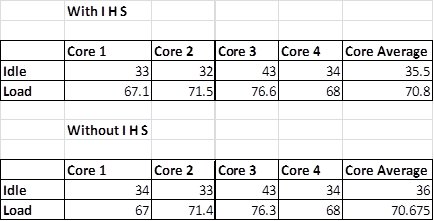
reports removing the internal heatspreader (IHS) of Intel's Ivy Bridge has little effect on the chip's temperatures, despite reports that the higher temperatures of Ivy Bridge could partly be caused because Intel used TIM instead of solder on the IHS:
As we can see, even with the cheaper thermal paste and the IHS layer removed, the cooling performance is relatively unchanged. This also allows a 5-percent margin of error. This is another piece of evidence to show that the heating performance is nothing to do with the IHS, by most likely something to do with Ivy Bridge's revised manufacturing process. This means that an Ivy Bridge should reach lower stable 24/7 clock speeds than a Sandy Bridge chip, but offer it with lower power consumption numbers.
 Posted on
by Thomas De Maesschalck


Comments (0)
No comments yet.