Tested: The performance impact of antivirus software
 Posted on
by Thomas De Maesschalck
AV Comparatives has published a report (PDF) in which they compare the performance hit of 20 of the most popular security software solutions. Testing was done on an Intel Core i5 system from HP with 4GB RAM, a mechanical HDD and Windows 8.1 64-bit to get a sense of the performance impact on an average out-of-the-box system.
Testing was done with the PCMark benchmark and AV-C, a test that measures how fast a system does tasks like file copying, archiving/unarchiving, installing/uninstalling, launching applications, and downloading files.
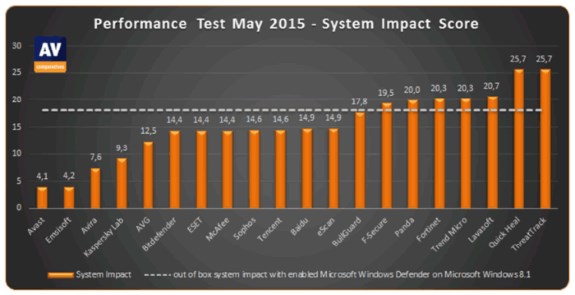
Every antivirus solution has an impact on system performance but the performance hit varies quite a lot:
Please be aware that these charts exclusively look at system performance and do not look at the level of protection offered. Fortunately, AV Comparatives recently tested the real-world protection of AV suites as well, you can find the June 2015 report over here (PDF).

Via: Hexus
Testing was done with the PCMark benchmark and AV-C, a test that measures how fast a system does tasks like file copying, archiving/unarchiving, installing/uninstalling, launching applications, and downloading files.
Every antivirus solution has an impact on system performance but the performance hit varies quite a lot:
With the tests in its back pocket AV Comparatives asserts that the best solutions, in terms of having the weakest impact on your PC's overall performance is Avast, followed by Emsisoft, Avira, Kaspersky and AVG. The worst performers under its assessment regime were Fortinet, Trend MICRO, Lavasoft, Quick Heal and ThreatTrack. Microsoft's own Windows Defender product was very much middle of the field.
Please be aware that these charts exclusively look at system performance and do not look at the level of protection offered. Fortunately, AV Comparatives recently tested the real-world protection of AV suites as well, you can find the June 2015 report over here (PDF).
Via: Hexus

Comments (0)
No comments yet.