Civilizations on Super-Earths may be stuck there
 Posted on
by Thomas De Maesschalck
Since the discovery of the first planets outside our own solar system, astronomers have discovered thousands more. The number of planets in the universe is truly staggering, but there are no good estimates. Some studies point to a couple of hundred billion galaxies in the galaxy, while others say it could be about two trillion. Each of these galaxies likely contains an average of 100 million stars, creating a truly astronomical figure for the number of possible planets in the universe.
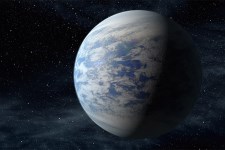
So far, a lot of the Earth-like planets we've found are Super-Earths. These are basically very large versions of Earth, and there appear to be a lot of them. Due to the thick atmospheres, these planets could be "super-habitable", as they offer adequate shielding from harmful cosmic rays.
The downside of living on a Super-Earth is that gravity is much higher. A new paper calculated that potential civilizations living on Super-Earth planets may not have access to space due to the much higher cost of reaching orbit. Launching large payloads into orbit is hard on Earth, but on more massive planets it gets exponentially harder due to the insane amount of fuel required to achieve the same feat:
So far, a lot of the Earth-like planets we've found are Super-Earths. These are basically very large versions of Earth, and there appear to be a lot of them. Due to the thick atmospheres, these planets could be "super-habitable", as they offer adequate shielding from harmful cosmic rays.
The downside of living on a Super-Earth is that gravity is much higher. A new paper calculated that potential civilizations living on Super-Earth planets may not have access to space due to the much higher cost of reaching orbit. Launching large payloads into orbit is hard on Earth, but on more massive planets it gets exponentially harder due to the insane amount of fuel required to achieve the same feat:
To launch the equivalent of an Apollo moon mission, a rocket on a super-Earth would need to have a mass of about 440,000 tons (400,000 metric tons), due to fuel requirements, the study said. That's on the order of the mass of the Great Pyramid of Giza in Egypt.Full details at Space.com.
"On more-massive planets, spaceflight would be exponentially more expensive," said study author Michael Hippke, an independent researcher affiliated with the Sonneberg Observatory in Germany. "Such civilizations would not have satellite TV, a moon mission or a Hubble Space Telescope."

Comments (0)
No comments yet.