DV Hardware bringing you the hottest news about processors, graphics cards, Intel, AMD, NVIDIA, ATi, hardware and technology!

   Home | News submit | News Archives | Reviews | Articles | Howto's | Downloads | Mirror Area | Advertise
 
DarkVision Hardware - Daily tech news
  Login/sign up  


Main Menu

Home
User account
Info
News archives
Links
Articles
Howto
Reviews
Member list
 

Who's Online
There are currently 306 people and 0 DV-member(s) online.


Latest Reviews
  • ATP EarthDrive 4GB USB Drive
  • Kingston DataTraveler 150 32GB USB drive
  • Super Talent Pico 8GB USB Drive
  • Razer Destructor mousepad
  • Ghost Squad for Nintendo Wii
  • OCZ DDR2 PC2-9200 Reaper HPC Edition
  • Vizo Ninja II notebook cooler
  • PC Power & Cooling Silencer 610 PSU
  •  

    RSS
    RSS
    RSS by email. Enter your email address:


    Recommended: Click here to Update all your outdated drivers

    Scientists find record-breaking black hole

    Posted on Wednesday, October 31 2007 @ 13:55:49 CET by Thomas De Maesschalck


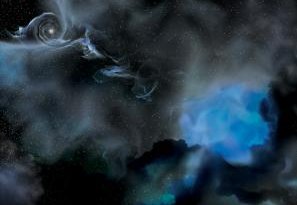
    Astronomers announced the discovery of a black hole with a mass 24 to 33 times that of our Sun that orbits a star.
    he newly discovered object belongs to the category of "stellar-mass" black holes. Formed in the death throes of massive stars, they are smaller than the monster black holes found in galactic cores. The previous record holder for largest stellar-mass black hole is a 16-solar-mass black hole in the galaxy M33, announced on October 17.

    "We weren’t expecting to find a stellar-mass black hole this massive," says Andrea Prestwich of the Harvard-Smithsonian Center for Astrophysics in Cambridge, Mass., lead author of the discovery paper in the November 1 Astrophysical Journal Letters. "It seems likely that black holes that form from dying stars can be much larger than we had realized."

    The black hole is located in the nearby dwarf galaxy IC 10, 1.8 million light-years from Earth in the constellation Cassiopeia. Prestwich’s team could measure the black hole’s mass because it has an orbiting companion: a hot, highly evolved star. The star is ejecting gas in the form of a wind. Some of this material spirals toward the black hole, heats up, and gives off powerful X-rays before crossing the point of no return.
    Source: Science Daily


    Add to Del.icio.us | Digg It

     
    Threshold
      
    The comments are owned by the poster. We aren't responsible for their content.
     

    DarkVision Hardware - Privacy statement
    All logos and trademarks are property of their respective owner.
    The comments are property of their posters, all the rest © 2002-2008 DarkVision Hardware