Posted on Wednesday, October 08 2008 @ 7:12 CEST by Thomas De Maesschalck
Researchers at Boston University are working on the next generation of wireless communications technology based on visible light instead of radio waves. Cellular News
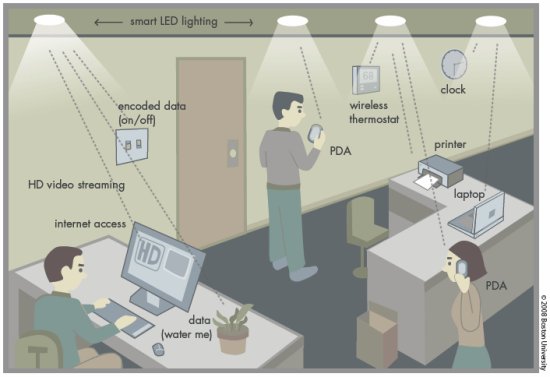
reports the scientists aim to create "Smart Lighting" LEDs with built-in data communications capabilities. This technology would work by flickering light in patterns - so fast the change is imperceptible to the human eye.
Boston University's College of Engineering is launching a program, under a National Science Foundation grant, to develop the next generation of wireless communications technology based on visible light instead of radio waves. Researchers expect to piggyback data communications capabilities on low-power light emitting diodes, or LEDs, to create "Smart Lighting" that would be faster and more secure than current network technology.
This initiative aims to develop an optical communication technology that would make an LED light the equivalent of a Wi-Fi access point.
"Imagine if your computer, iPhone, TV, radio and thermostat could all communicate with you when you walked in a room just by flipping the wall light switch and without the usual cluster of wires," said BU Engineering Professor Thomas Little. "This could be done with an LED-based communications network that also provides light - all over existing power lines with low power consumption, high reliability and no electromagnetic interference. Ultimately, the system is expected to be applicable from existing illumination devices, like swapping light bulbs for LEDs."