Posted on Tuesday, October 21 2008 @ 5:45 CEST by Thomas De Maesschalck
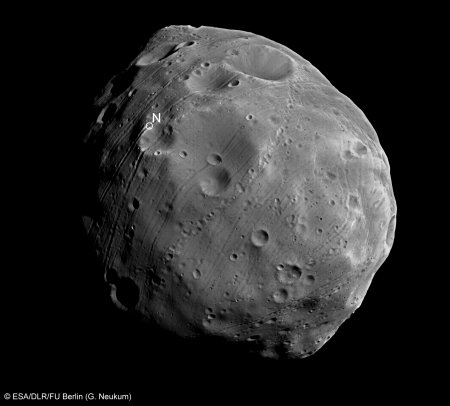
ESA published a report on the origin of Phobos, Mars' larger moon. The scientists write the moon looks almost certain to be a "rubble pile" held together by gravity, rather than a single solid object.
Unlike Earth, with its single large moon, Mars plays host to two small moons. The larger one is Phobos, an irregularly sized lump of space rock measuring just 27 km x 22 km x 19 km.
...
Preliminary density calculations suggest that it is just 1.85 grams per cubic centimetre. This is lower than the density of the martian surface rocks, which are 2.7-3.3 grams per cubic centimetre, but very similar to that of some asteroids.
The particular class of asteroids that share Phobos’ density are known as D-class. They are believed to be highly fractured bodies containing giant caverns because they are not solid. Instead, they are a collection of pieces, held together by gravity. Scientists call them rubble piles.
Also, spectroscopic data from Mars Express and previous spacecraft show that Phobos has a similar composition to these asteroids. This suggests that Phobos, and probably its smaller sibling Deimos, are captured asteroids. However, one observation remains difficult to explain in this scenario.
Usually captured asteroids are injected into random orbits around the planet that gravitationally tie them, but Phobos orbits above Mars’ equator – a very specific case. Scientists do not yet understand how it could do this.
In another scenario, Phobos could have been made of martian rocks that were blasted into space during a large meteorite impact. These pieces have not fallen completely together, thus creating the rubble pile.
More info
at ESA.