Posted on Thursday, February 19 2009 @ 21:01 CET by Thomas De Maesschalck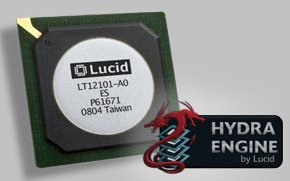
Cohen unveiled the Hydra has a TD of around 4W and that these chips have a built-in RISC processor. ELSA Japan is implementing the chip as a PCI Express controller for use with NVIDIA Tesla cards in GPGPU applications, in this non-graphics mode the Hydra supports up to four graphics cards.
When used for graphics processing, the Hydra Engine is limited to two cards at the moment, but Lucidlogix is working to expand this to up to four cards. And in theory, it should even be possible to use eight cards by cascading multiple Hydra chips.
The reason why Hydra scales so well is because its the Hydra chip that controls the rendering and Lucidlogix is doing it quite different than the way AMD and Nvidia are doing things. Using multiple graphics cards have so far meant alternate frame rendering, split screen rendering or tile based rendering. Lucidlogix on the other hand is going for object based rendering which is an entirely new approach which means that each GPU get allocated parts of an object of the scene that's being rendered and then the Hydra chip pieces together the small parts into the final frame which is then displayed on the screen.More details may be revealed at CeBIT next month.