DV Hardware bringing you the hottest news about processors, graphics cards, Intel, AMD, NVIDIA, ATi, hardware and technology!

   Home | News submit | News Archives | Reviews | Articles | Howto's | Advertise
 
DarkVision Hardware - Daily tech news
June 20, 2013 
Main Menu

Home
Info
News archives
Links
Articles
Howto
Reviews
 

Who's Online
There are currently 121 people online.


Latest Reviews
Antec soundscience halo 6 LED bias lighting kit
Noctua NM-I3 SecuFirm2 Mounting Kit
Two months with Windows 8
Cooler Master Silencio 650
CM Storm QuickFire TK mechanical keyboard
Kingston HyperX 3K 240GB SSD
Sennheiser HD 555
ROCCAT Pyra Wireless mouse
 

RSS
RSS


Stanford reveals first million-core supercomputer

Posted on Monday, February 04 2013 @ 15:32:28 CET by


Researchers at the Center for Turbulence Research at Stanford University set a new record by building the first supercomputer with over 1 million processor cores. The newly installed Sequoia IBM Bluegene/Q system at Lawrence Livermore National Laboratories employs a whopping 1,572,864 compute cores (processors) and 1.6 petabytes of memory connected by a high-speed five-dimensional torus interconnect, and has been successfully used to solve a complex fluid dyanmics problem. Full details at Stanford.
“Computational fluid dynamics (CFD) simulations, like the one Nichols solved, are incredibly complex. Only recently, with the advent of massive supercomputers boasting hundreds of thousands of computing cores, have engineers been able to model jet engines and the noise they produce with accuracy and speed,” said Parviz Moin, the Franklin M. and Caroline P. Johnson Professor in the School of Engineering and Director of CTR.

CFD simulations test all aspects of a supercomputer. The waves propagating throughout the simulation require a carefully orchestrated balance between computation, memory and communication. Supercomputers like Sequoia divvy up the complex math into smaller parts so they can be computed simultaneously. The more cores you have, the faster and more complex the calculations can be.

And yet, despite the additional computing horsepower, the difficulty of the calculations only becomes more challenging with more cores. At the one-million-core level, previously innocuous parts of the computer code can suddenly become bottlenecks.
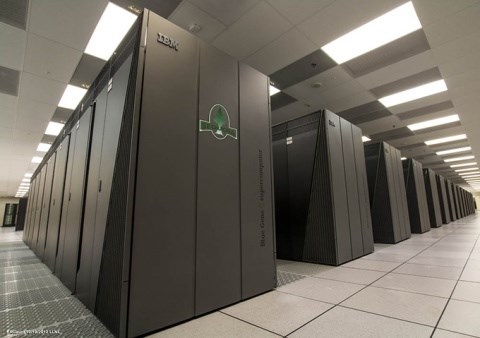
Stanford supercomputer

Source: Legit Reviews


DV Hardware - Privacy statement
All logos and trademarks are property of their respective owner.
The comments are property of their posters, all the rest © 2002-2013 DM Media Group bvba