Posted on Saturday, July 16 2005 @ 0:50 CEST by Thomas De Maesschalck
ExtremeTech gives us a closer look at NVIDIA's new Transparency Adaptive AA feature which came with the NVIDIA GeForce 7800 GTX.
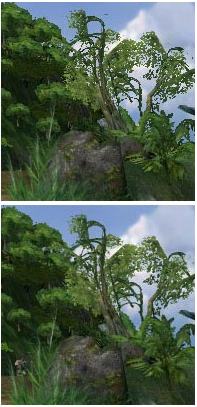
Before we present quality samples and benchmarks, we should explain what exactly this "Transparency Adaptive Anti-Aliasing" is. Here's the simple layman's-term explanation: Normal multisample anti-aliasing, which all current video cards use, only cleans up the edges of polygons. TAAA can take a polygon or object that has some "clear" texture in it, like a chain link fence, leaves on a tree, or tufts of grass, and smooth out the edges of the objects those textures represent. It's AA "within" a polygon or object, provided the object has some see-through areas.
Transparency AA isn't performed on the entire frame: That would be slow and inefficient. An object/poly to be rendered must first have alpha test enabled. Then one of two transparency AA modes will be applied—multisampling or supersampling—depending on which you choose in the control panel..
When looking at the screenshots over at Extreme Tech we can conclude that TAAA greatly improves image quality, but does it really works perfectly? Check out the full article and ExtremeTech's conclusions
over here. They end with saying that TAAA promises to be a good technology, but it has still bugs which result in some annoying visual bugs in today's most popular games.